.png)


Jian’s Garden—The Japanese Tiger Lily
From a Supermarket Bulb to an Unexpected Summer Bloom
By Dr. Jian Zhang
Some of the most joyful surprises in Jian’s Garden do not begin in a nursery. This one began in the produce section of an Asian supermarket.
A few months ago, I bought fresh lily bulbs for cooking. Each bulb was made of many
overlapping white scales, almost like flower petals hidden beneath the soil. I removed and
cooked the outer layers, but instead of throwing away the small central cores, I planted them in the garden.
I did not know exactly what would happen. I simply placed the cores in the soil, watered them
and waited.
They grew remarkably easily.
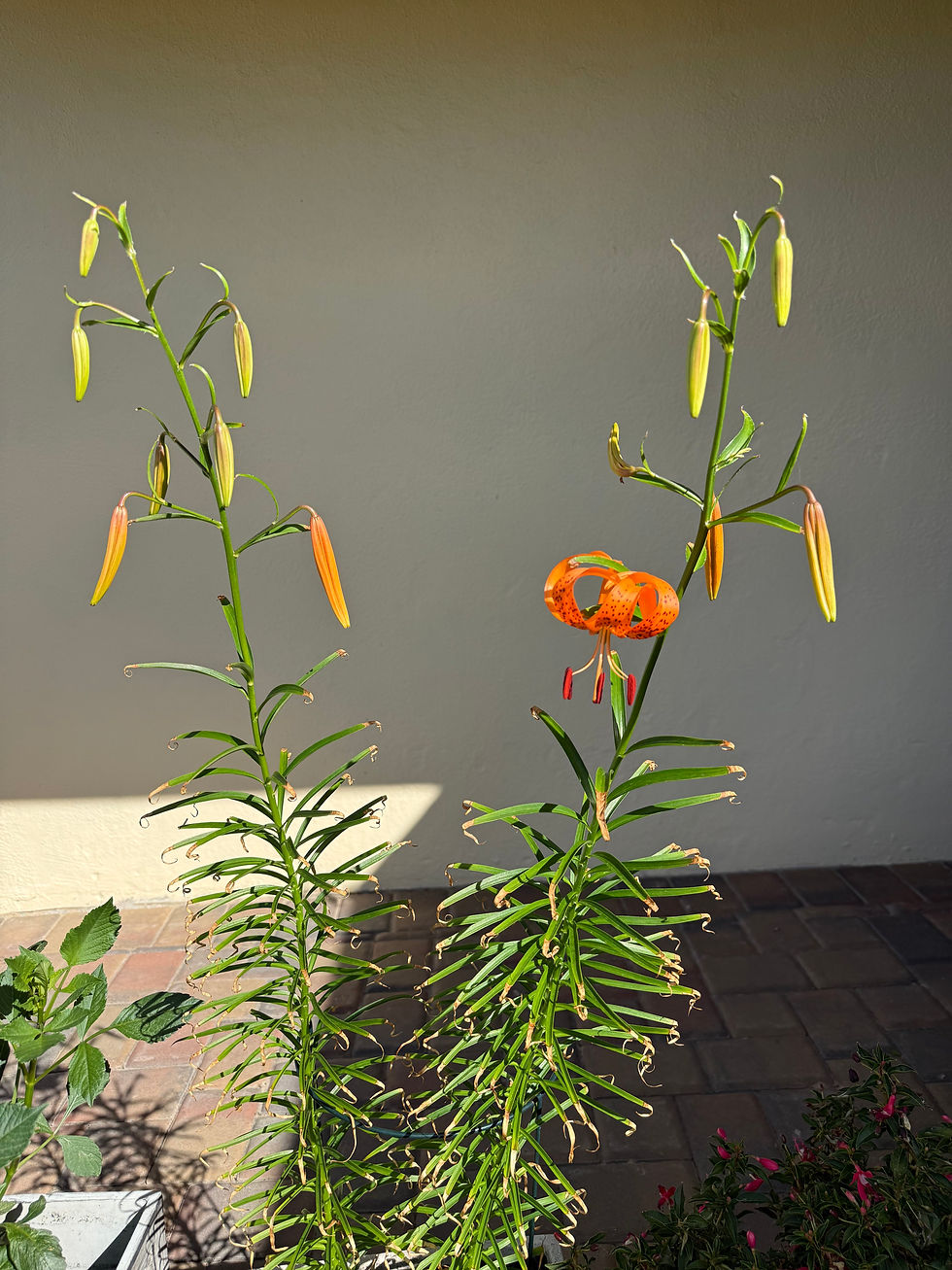
First came the slender green shoots. Then the stems became taller and taller, eventually rising several feet above the garden. Narrow leaves appeared along the stems, followed by clusters of long green buds.
And then, yesterday morning, the first bud opened.
Before me was a flower I had never seen in person—a brilliant orange lily with dark spots,
dramatically curled petals and long stamens hanging gracefully beneath it. The bloom looked
almost sculptural, like a glowing orange lantern suspended in the garden.
For me, the excitement of seeing these completely new flowers emerge from something I had planted only a few months earlier was priceless. Gardening often asks us to wait without
knowing exactly what will come. When the surprise finally reveals itself, the experience is filled with wonder.
Fiery Beauty in the Garden
This flower appears to be the Japanese tiger lily, botanically known as Lilium lancifolium. It is
also called 卷丹百合 or 虎皮百合 in Chinese.
Its fiery orange petals curl backward as though they are dancing. Dark crimson spots cover the petals, while the deep red anthers hang below like delicate ornaments. Against the green lawn and blue summer sky, the flowers are impossible to overlook.
Each blossom is bold, elegant and full of movement. Yet the flowers last only for a limited time, reminding us that part of beauty lies in its impermanence. Many unopened buds remain along the tall stems, allowing the garden to reveal its beauty gradually—one flower and one morning at a time.
Beauty Above, Nourishment Below
What makes this lily especially meaningful is that it offers beauty above the soil and
nourishment beneath it.
The part commonly called the lily “root” is actually a bulb composed of fleshy scales. Edible lily bulbs have long been used in Asian cooking. When cooked, they become tender and slightly creamy, with a mild sweetness and a delicate earthy flavor.
They contain carbohydrates and starch, along with dietary fiber, some protein, vitamins, minerals and naturally occurring plant compounds. Lily bulbs can be steamed, stir-fried, added to soups and congee, or prepared in sweet desserts.
In traditional Chinese food culture and herbal practice, the dried edible lily bulb is known as 百合—bǎi hé. It has traditionally been used to nourish yin, moisten dryness and calm the spirit. While these traditional uses should not be considered substitutes for medical treatment, they reflect the lily bulb’s long history as both a food and an herb.
Only lily bulbs clearly identified and sold for culinary use should be eaten. Ornamental lilies
may have been treated with chemicals or may not be suitable for consumption. Lilies are also
highly toxic to cats, including their flowers, leaves, stems and pollen.
A Lesson in Renewal
The most meaningful part of this experience is the transformation itself.
I ate the mature outer scales and planted the small cores that remained. They seemed like
leftovers, yet each core quietly contained the possibility of an entirely new plant.
Within only a few months, those small pieces became tall green stems covered with buds and magnificent orange flowers.
Nature reminds us that what appears to be the end of something may actually be the beginning of something else. A small remnant can carry new life. What nourishes us today can, with care and patience, return as unexpected beauty tomorrow.
These Japanese tiger lilies now stand like bright orange lanterns in Jian’s Garden. Their bulbs nourished our family at the table. Their cores returned to the earth. And their flowers have given me something equally nourishing—the priceless joy of witnessing a flower I had never seen before come into bloom.
From the supermarket to the kitchen, and from the kitchen to the garden, this lily
completed a beautiful circle of nourishment, renewal and discovery.
~~~
建清花园——日本百合:从餐桌到花园的惊
喜
一颗超市百合,几个月后的盛夏绽放
作者:张建博士
建清花园里,许多最美的风景,并不是从花圃买来的,而是来自生活中的一个小小念头。
几个月前,我在亚洲超市买了几颗新鲜百合,原本只是为了做菜。百合由一片片洁白肥厚
的鳞片组成,像一朵尚未开放的花。我把外面的鳞片剥下来做菜,却没有把中间小小的球
心丢掉,而是随手埋进了花园里。接下來我每次都把球心種在花園一角,現在已經有很多
棵了。
当时,我并不知道它会长成什么样子,只是抱着试一试的心情。
没想到,它们生长得非常容易。
没过多久,一根根嫩绿的新芽破土而出,慢慢长成挺拔的花茎。细长的叶片沿着茎秆整齐
排列,一个个花苞悄然形成,直到盛夏的昨天早上,第一个花苞终于绽放。
眼前出现的是一种我从未亲眼见过的花。
橙红色的花瓣向后优雅地卷曲,点缀着深色斑点,长长的花药自然垂下,仿佛一盏悬挂在
空中的橙色灯笼,又像一位正在翩翩起舞的舞者。
对于我来说,最珍贵的,不只是花开,而是亲眼看见一种自己从未见过的花,在自己亲手
种下的植物上第一次绽放。
这种惊喜,是任何金钱都无法衡量的。
盛夏里最耀眼的风景
这种百合属于日本虎皮百合(卷丹百合,Lilium lancifolium)。
它的花朵充满力量,却又十分优雅。
橙色花瓣鲜艳夺目,向后自然翻卷,深褐色的斑点像艺术家随意洒下的墨点,长长的雄蕊
轻轻摆动,在阳光下格外醒目。
站在建清花园里,蓝天、白云、绿草与橙色百合相互映衬,每一次经过,都忍不住停下来
欣赏几分钟。
更令人期待的是,一株百合并不会同时开放所有花朵。一个个花苞依次绽放,让整个花期
持续数周,每一天都会带来新的惊喜。
地下是食材,地上是风景
百合之所以特别,在于它不仅赏花,更能食用。
我们平时吃的百合,其实不是根,而是由一片片肥厚鳞片组成的地下鳞茎。
百合富含淀粉、膳食纤维、多种维生素、矿物质及植物活性成分,口感细腻、微甜,可以
炒、煮、蒸、炖汤,也可以加入粥品和甜品。
在中医里,百合已有数千年的应用历史。
《本草纲目》记载,百合具有养阴润肺、清心安神的传统用途,因此既是食材,也是常见
的药食同源植物。当然,这属于传统中医理论,不能替代现代医学治疗,但作为一种健康
食材,百合一直深受人们喜爱。
需要提醒的是,只有明确作为食用百合出售的品种才适合食用。观赏百合可能经过农药处
理,并不建议食用;同时,所有真百合植物对猫都具有极强毒性,家中养猫的人需要特别
注意。
生命,总会带来意想不到的惊喜
这次种植百合,让我再次体会到园艺最迷人的地方。
你把一颗不起眼的小球埋进土里,它不会立刻给你答案。
它需要阳光、雨水、耐心和时间。
几个月后,它却送给你一份完全超出期待的礼物。
我吃掉了外层最丰厚的鳞片,却把看似不起眼的球心留给了土地。没想到,正是这个小小
的球心,孕育出一株高大的百合,开出了我从未见过的美丽花朵。
生命常常如此。
我们以为已经结束的东西,也许只是另一段旅程的开始;我们以为微不足道的部分,也许
蕴藏着最大的生命力。
对于我来说,这些日本百合,不仅丰富了建清花园,更让我重新感受到探索自然的快乐。
园艺最大的收获,不只是拥有一座美丽的花园,而是在等待中收获惊喜,在惊喜中重新发
现生命的无限可能。
从超市到餐桌,从餐桌到花园,一颗百合完成了一次关于生命、健康与美丽的奇妙旅程。


Comments